SOI Asia — School on Internet Asia
Educational and research collaboration across Asia-Pacific universities.

About the Collaboration
SOI Asia (School on Internet Asia) is an international education consortium established in 2001 by the WIDE Project to build educational collaboration among leading universities across Southeast Asia over the Internet, using the network infrastructure developed under the AI3 (Asian Internet Interconnection Initiatives) Project — a community that itself dates back to 1996. Pulchowk Campus participates in SOI Asia as one of its partner universities, engaging students and faculty in its network-engineering, digital-humanities, and community-research sub-projects.
Projects
APIE — Asia Pacific Internet Engineering Program
A structured pathway for training the next generation of network engineers. APIE combines self-paced online courses (Understanding the Internet, Operating the Internet), a bi-weekly e-Workshop series with industry and academic guest speakers, and a hands-on, 5-day APIE Camp covering switch/router configuration, virtualization, network security, DNS, IoT, and cloud integration. Learners work in teams with peers from partner universities across the region and can progress to an APIE internship.
DHASH — Digital Humanities / Archive Sub-project
A collaboration among four universities — Universitas Syiah Kuala and Universitas Brawijaya (Indonesia), Tribhuvan University (Nepal), and Keio University (Japan) — building an Open Science Infrastructure to support digital-humanities work in the Asia-Pacific region. Under DHASH, the Tribhuvan University team’s project preserves traditional Nepali instruments by digitizing them into VST plugins (“The Sound of Sarangi”), alongside sister efforts in mixed-reality and 3D digital archiving in Indonesia.
EBA — Evidence Based Approach Project
A fieldwork-based sub-project that trains students to design and run evidence-based, community-grounded research. EBA Fieldwork alumni, together with APIE Camp alumni, form the pipeline of students eligible to advance into SOI Asia’s collaborative research programs, such as CBR Seed.
CBR — Community-Based Research (CBR Seed)
A program that funds student-led, community-based research teams to co-create real-world, technology-driven solutions with peers from SOI Asia partner universities. Open to APIE Camp and EBA Fieldwork alumni, teams are guided by faculty mentors from their home institutions through proposal, matchmaking, and execution.
APIE Camp #11 at IOE-TU
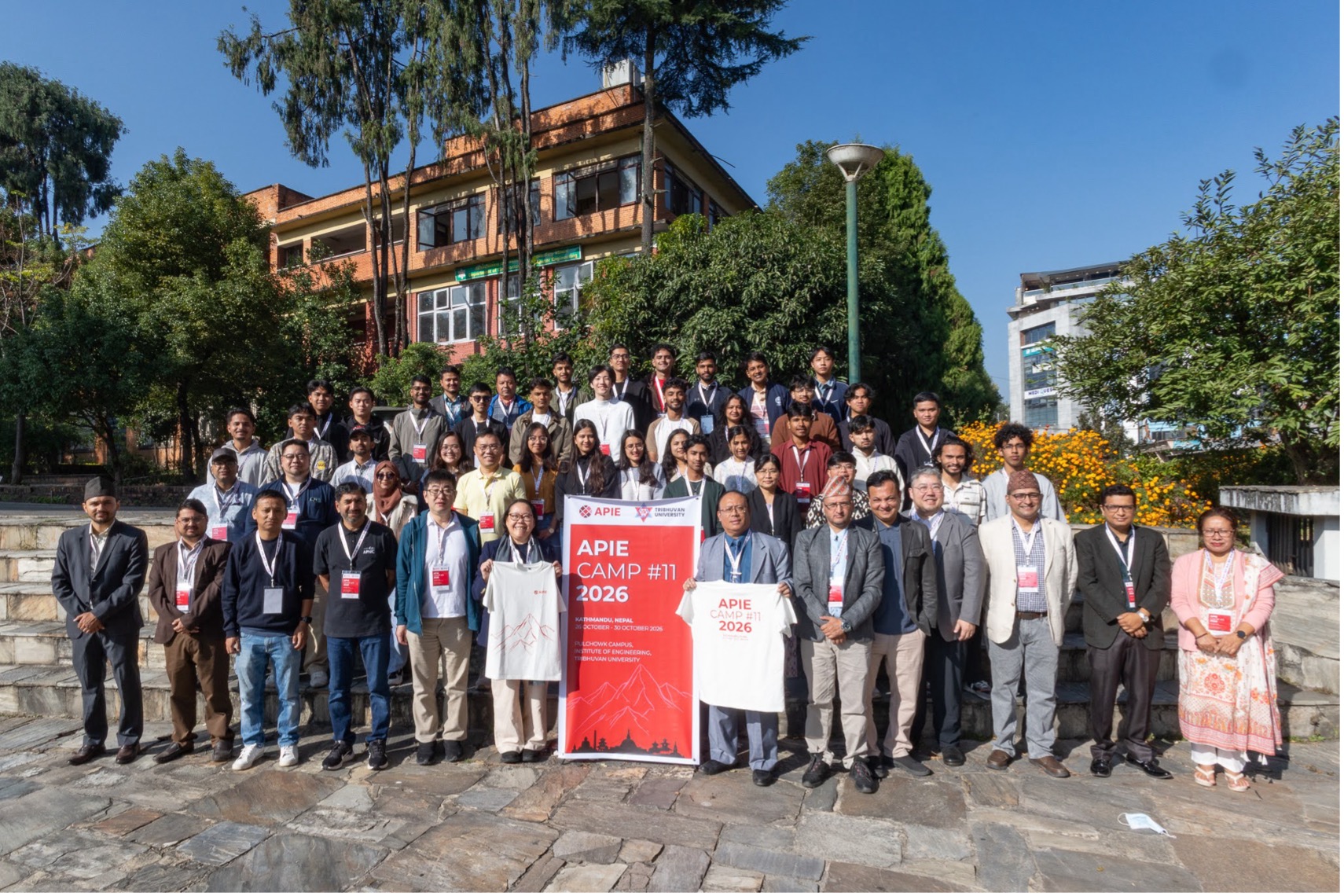
Pulchowk Campus hosted the 11th Asia Pacific Internet Engineering (APIE) Camp at the Information and Communication Technology Center (ICTC) from 26 to 30 October 2026. Organised with SOI Asia and Keio University, the five-day camp brought together 24 students: 12 from Tribhuvan University and 12 from nine partner universities in Bangladesh, Indonesia, Japan, Malaysia, Myanmar, the Philippines and Thailand.
Working in mixed teams, participants moved from physical networking to cloud services through lectures and hands-on labs:
- Day 1 – Network Deployment: cabling, wireless access points, IP addressing, VLAN, NAT and OSPF routing
- Day 2 – Network Virtualization: hypervisors, Linux, and network and cyber security
- Day 3 – DNS: DNS setup and secondary server configuration
- Day 4 – IoT and Cloud Computing: introduction to IoT, AWS and next-generation networks
- Day 5 – Industry Visit: a visit to Data Hub Nepal, followed by final presentations and the closing ceremony
Beyond the technical training, the camp gave students exposure to data-centre infrastructure and a chance to build connections with peers and faculty from across the region. The networking equipment arranged for the camp also strengthens the networking laboratory at IOE-TU.
IOE-TU thanks SOI Asia, Keio University, the APIE organising team, the participating universities, and the advisors, organising committee and staff who made the camp possible.
What Students Gain
- Cross-border collaboration with students from partner universities across the Asia-Pacific region
- Hands-on network engineering skills and industry exposure through APIE
- Research experience in digital humanities and community-based projects through DHASH, EBA, and CBR
- Digital badges and certificates recognizing each completed component